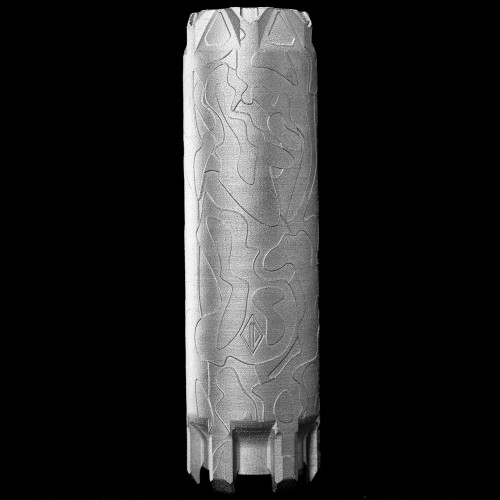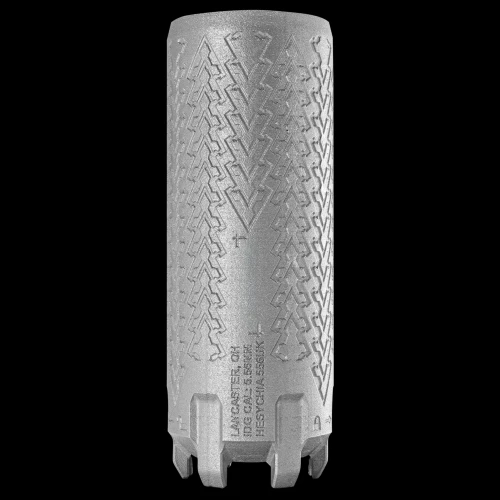


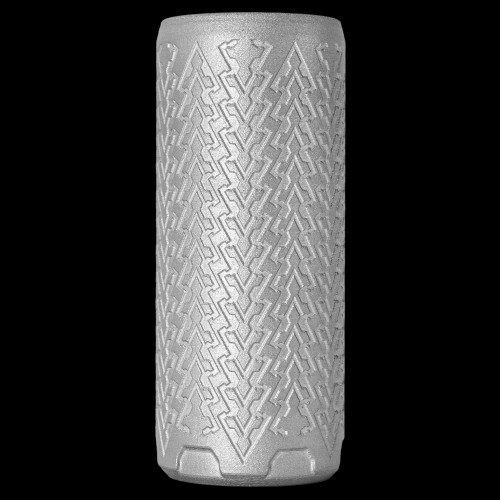
What the 556UK-H Is Built Around
| Caliber | 5.56MM NATO |
| Weight | 11 oz |
| Overall Length | 4.18" |
| Length Added to Muzzle Device | Mount Dependent |
| Diameter | 1.75" |
| dB at Ear | 136 dB, MD Dependent |
| dB at Muzzle | 140 dB, MD Dependent |
| Test Platform | DD MK18 10.3 |
| Material | Inconel 718 |
| Manufacturing | Laser Powder Bed Fusion (LPBF) |
| Gas Profile | Low Backpressure |
| Mount | HUB 1.375-24 TPI |
| Full Auto Rated | Yes |
| Chamber Depth | 1.34" |
| Compatible Muzzle Devices | HFH, Micro FE |
| Barrel Guidance | Full auto rated for 10.3" barrels and above |
| MSRP | 825 |
Every Decision Starts With Shootability
The 556UK-H is the HUB version of the Hesychia 556UK. It keeps the same core design logic in a cross-compatible format for shooters who need a 1.375-24 TPI HUB interface instead of the native Hesion Bow lock.
That flexibility comes with known packaging tradeoffs. In the native system, space around and between locking features can be used for additional gas pockets and disruption. In a HUB suppressor, a larger threaded region consumes space that cannot be used for gas pockets, disruption features, or flow-shaping geometry. The 556UK-H is still an ultra compact suppressor, but its internal volume and leverage differ from the native 556UK because of that packaging change.
- HUB 1.375-24 TPI interface
- HUB version of the Hesychia 556UK
- 4.18" overall length
- 2.8" between blast baffle and front face
- 11 oz Inconel 718 construction
- No tuning required
Because the 556UK-H is a HUB suppressor, the muzzle device used inside the suppressor has a drastic effect on overall performance. Muzzle brake or compensator type devices typically offer better suppressed performance, while open tine or caged flash hiders tend to have a slightly negative effect on suppressor performance and can degrade the internal structure faster over time. That is because a brake takes a large portion of the uncorking pressure and diverts it into the blast chamber walls rather than allowing that first pressure event to impact the face of the blast baffle directly.
The 556UK-H uses the same gas-management philosophy as the native 556UK, applied to a HUB envelope. It is still a low back pressure suppressor with strong tone and flash control for its size, but some of the packaging efficiency of the native system is traded for HUB compatibility and muzzle device flexibility.
Back-pressure is controlled at the beginning. The muzzle device, blast chamber, early intake geometry, and first redirections matter more than most suppressor marketing will ever admit. That is where the real leverage is.
Gas enters a radial diamond structure in the initial chamber, gets disrupted and cooled, then gets pulled into annular pathways early, before the first blast baffle has a chance to become a pressure traffic jam. The goal is not simply to trap more gas. The goal is to move pressure off the muzzle immediately and distribute it across the entire suppressor so the gun cycles more like itself.
Laser Powder Bed Fusion matters here because the gas management architecture would be crippled if it had to be designed around drill paths, lathe access, or simple stacked components. Early annular intakes, captured helix paths, shielded ports, and complex exterior textures are possible because the structure is printed as one piece and the critical interfaces are machined afterward.
Inconel 718 is the material choice because it holds its shape, resists erosion, and survives thermal cycling in a way that fits what this suppressor is built to do. It is not the lightest option and not the cheapest option. It is the one that makes the geometry viable under real rifle heat and use cycles.
The 556UK-H was designed for shooters who want the 556UK's gas and flash behavior in a HUB format, with weight and length pulled down as far as practical. It is an ultra compact, low back pressure suppressor that can live on a duty rifle without turning host tuning into the shooter's problem. If you need maximum abuse margin in this family, the Hesychia SIXK is the better option.
The 556UK-H manages flash with the same overall principles as the 556UK. It biases toward a higher compartmentalized pressure zone and uses a deep recessed exit aperture region so the six exit ports pull gas from the central core where mixing is at its highest, rather than simply venting directly out of the bore line.
The isolated annular pockets at the nose vary the rate of flow and encourage gas to exit at an angle away from the bore path. That drastically reduces the typical crack associated with K-sized 5.56 suppressors while keeping flash behavior controlled for such a short package.
The 556UK-H is built to work with both the Hybrid Flash Hider (HFH) and the Micro Flow Enhancer, depending on how the rifle will actually be used.
Use the HFH when the rifle will spend meaningful time both suppressed and unsuppressed. It is the more balanced choice for a mixed-use host, with stronger unsuppressed flash outcome and host behavior that makes more sense when the can comes off. On the 556UK-H, you will need the Hesion Bow HUB Adapter to run the HFH, since the device itself is a Hesion Bow mount and the 556UK-H is a HUB-threaded suppressor.
Use the Micro Flow Enhancer when the host is realistically going to live suppressed. The Micro FE sits very close to the blast baffle and is part of the suppressor's first-stage gas control, routing gas aggressively into the annular and helix paths to maximize suppressed flash and tone performance. To use the Micro FE with the 556UK-H, you must run it through the Hesion Bow HUB Adapter, because the Micro FE is a Hesion Bow muzzle device.
For the 556UK-H there is no Macro FE path. The Macro FE is too long to work within the 556UK geometry when using the Hesion Bow HUB Adapter.
The 556UK-H is full auto rated for 10.3" barrels and above. Going shorter increases blast baffle erosion and raises projectile stability risk.
The design target was not just to add a HUB thread to the 556UK. The design target was to keep as much of the 556UK's shootability, flash behavior, and low back pressure as possible in a cross-compatible format, while acknowledging the volume and geometry tradeoffs that come with a HUB mount.
We designed a suppressor system that does not need any tuning for any firearm host it mounts to. If the customer has to spend additional money on adjustable gas blocks, heavier buffers, or different springs just to make our suppressor work on their rifle, then we did not hit our goal. Can you tune your firearm to run it even better. Absolutely. But it is not required.
Keep It Running
The 556UK-H is a sealed monolithic unit. There are no user-serviceable internal components and no baffles to remove individually. Maintenance is straightforward. Start with correct setup logic, a clean interface, proper alignment, and realistic host expectations.
- Install muzzle devices or direct thread adapter to the manufacturer's spec
- Threadlocker for the HUB adapter to the suppressor is highly encouraged
- Always use an alignment rod before shooting for the first time
- Your suppressor's performance will vary depending on what muzzle device you are using
Install to whatever specification your muzzle device manufacturer dictates. If you are using IDG muzzle devices, reference our FAQ for guidance.
Always use an alignment rod before shooting for the first time. Ensure the HUB adapter is installed correctly and follows the guidelines the manufacturer dictates. IDG is not liable for improper use of third-party mounting systems that result in damage to the suppressor.
Use caution when shooting a newly assembled suppressor for the first time to ensure the mounting system was installed correctly and that the caliber you are sending through the suppressor is under the caliber rating engraved on the suppressor.
For the full engineering deep-dive, visit our Tech Talk page. For setup questions, Hesion Bow HUB adapter use, and device pairing logic on the 556UK-H, check the IDG FAQ.
1 Review Hide Reviews Show Reviews
-
556UK Hub
Pleasantly surprised how good the sound reduction was on such a small can. Love how small and lightweight it is. Exactly what I was looking for. I need a couple more! Great service from the folks at Irregular Design, Sarah was awesome at getting this to me as quick as possible. Thank you!