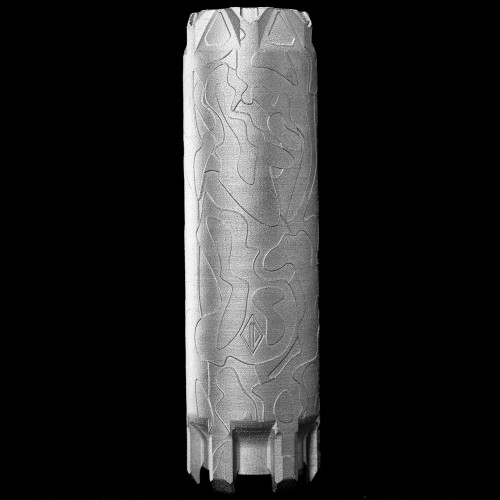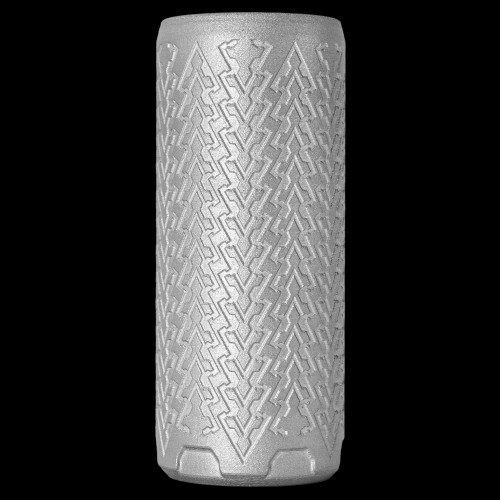


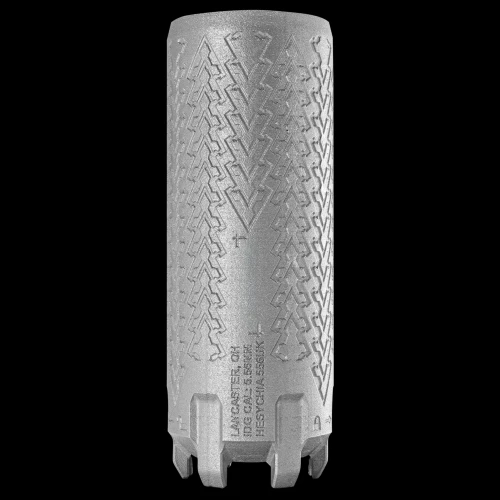
What the 556UK Is Built Around
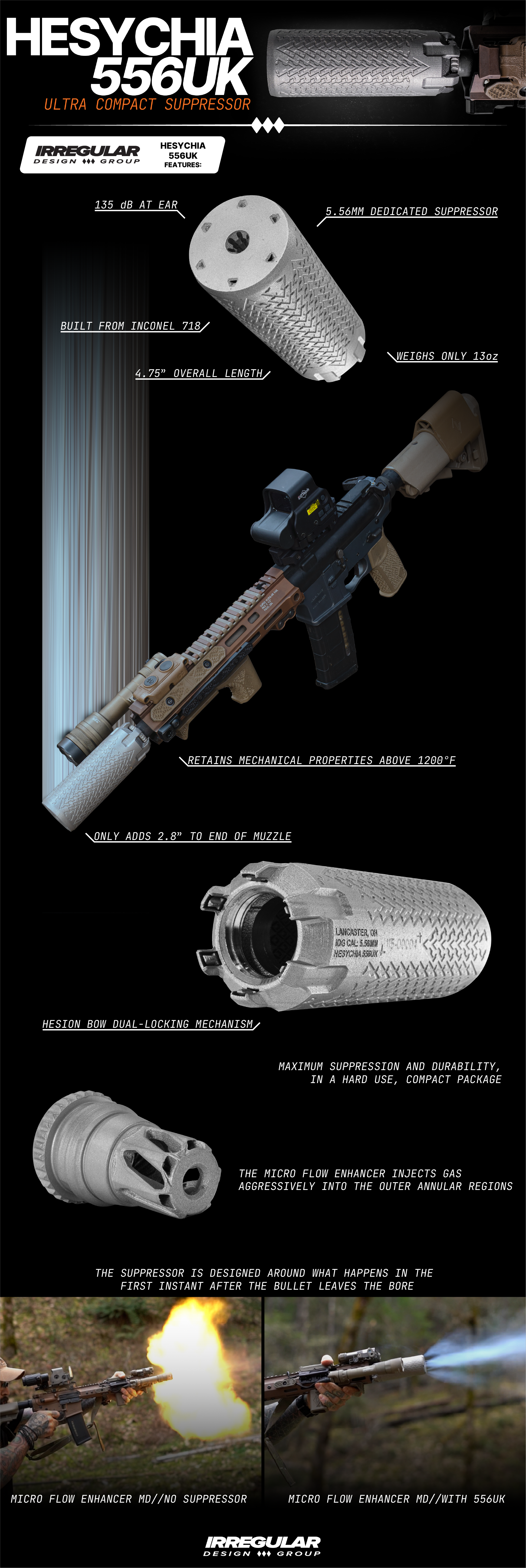
Expanded Specifications
| Caliber | 5.56MM NATO |
| Weight | 13 oz |
| Overall Length | 4.75" |
| Length Added to Muzzle Device | 2.6" |
| Diameter | 1.75" |
| dB at Ear | 135 dB |
| dB at Muzzle | 138 dB |
| Test Platform | DD MK18 10.3 |
| Material | Inconel 718 |
| Manufacturing | Laser Powder Bed Fusion (LPBF) |
| Gas Profile | Low Backpressure |
| Mount | Hesion Bow |
| Full Auto Rated | Yes |
| Compatible Muzzle Devices | Micro HFH, Micro FE |
| Barrel Guidance | Full auto rated for 10.3" barrels and above |
| MSRP | 975 |
Compact Length Without Compact Thinking
The Hesion Bow is a dual-locking mechanism built to keep the suppressor mechanically secure without adding clumsy bulk or complicated handling. Flexure pawls are printed directly into the suppressor body under protective hoods, creating six bi-directional indexing arms that engage 32 grooves around the muzzle device. The retention system is integral to the suppressor itself, not an added sleeve or separate latch.
The primary lock remains the 15-degree taper paired with the 1 1/8"-8 left-hand American Buttress Thread. That taper creates the clamping force that seals gas and preserves concentric alignment, while the coarse buttress thread gives fast engagement and strong load transfer without unnecessary rotations.
The point is not novelty for its own sake. The point is a mount that feels mechanically sure of itself when the rifle is hot, dirty, and actually being used. Two is one, one is none.
- Six flexure pawls printed into the suppressor body
- Thirty-two locking grooves on the muzzle device
- Integral redundant retention
- 15-degree taper primary lock
- 1 1/8"-8 left-hand American Buttress Thread
- Fast engagement with minimal rotation
The 556UK follows the same system logic as the larger cans, but in a package where internal volume is tighter and every geometric decision matters more. Back-pressure is managed at the beginning, not treated as a downstream cleanup problem. The blast chamber, early intake geometry, and first redirections are where the real leverage lives.
This suppressor was not built around simply trapping more gas and hoping the host tolerates it. It was built to move pressure off the muzzle quickly, route it with intent, and keep the gun feeling more like itself instead of turning the host into a tuning project.
The 556UK uses the same asymmetric, multi-stage gas management philosophy as the rest of the family. Early annular intake, controlled routing, staggered internal events, and shielded final exits all work together as one system. This is not a stack of disconnected tricks. It is one architecture tuned around keeping length down without letting tone, flash, and gas behavior fall apart.
That is the real challenge of an ultra-compact rifle suppressor. Small cans get unpleasant fast when the geometry is lazy. The 556UK was built to stay mechanically disciplined and shooter-friendly despite the tighter envelope.
The 556UK was built to give a real rifle a shorter suppressor without accepting the usual penalties as unavoidable. The target was compact size, low gas to the shooter, strong flash control for the envelope, good tone at the ear, durability under hard use, and no tuning required to make the system function the way it should.
Most ultra-compact rifle suppressors accept harsh tone, abrupt pressure behavior, and compromised flash performance as the price of short length. The shooter gets the consequences.
The 556UK treats the muzzle device and early blast geometry as part of the suppressor's first-stage gas control. The Micro Flow Enhancer and Micro Hybrid Flash Hider are not accessories in the casual sense. They are part of how the can actually works.
On the 556UK, the Micro Hybrid Flash Hider and Micro Flow Enhancer are the intended pairings. The suppressor is built around that first pressure event being handled correctly at the muzzle device, not after pressure has already stacked up in the can. That is part of why the package stays compact without behaving like a typical short, high-back-pressure can.
Use the Micro HFH when the rifle spends meaningful time both suppressed and unsuppressed. Use the Micro FE when the host is realistically going to live suppressed.
The 556UK is full auto rated for 10.3" barrels and above. The minimum recommended barrel length for current 5.56 rifle suppressors in this system is 10.3", and going shorter increases blast baffle erosion and raises projectile stability risk.
This suppressor was not built to win a single spec sheet argument. It was built for the shooter who wants a shorter system on the rifle without turning the whole host into a compromise. That means balancing flash, tone, gas behavior, durability, and overall length as a real package instead of pretending one number tells the whole story.
We designed a suppressor system that does not need any tuning for any firearm host it mounts to. If the customer has to spend additional money on adjustable gas blocks, heavier buffers, or different springs just to make our suppressor work on their rifle, then we did not hit our goal. Can you tune your firearm to run it even better. Absolutely. But it is not required.
Keep It Running
The 556UK is a sealed monolithic unit. There are no user-serviceable internal components and no removable baffle stack. Maintenance starts with correct setup, clean interfaces, proper taper seating, and realistic use expectations.
Start with clean parts, correct torque, and proper taper engagement. Install the muzzle device to the barrel at 30 ft./lbs. Timing is not required for the Micro Hybrid Flash Hider or Micro Flow Enhancer, and threadlocker is not normally required under standard installation. Before mounting, make sure the taper and mating surfaces are clean so the suppressor seats on the taper rather than hanging up on debris or a false stop.
New systems should be mounted, seated, removed, and repeated for roughly 5 to 7 cycles. That initial wear-in helps the interfaces settle correctly. After that, do a short validation firing sequence and inspect for stable mounting, normal recoil impulse, and no evidence that the suppressor is walking off or the host is behaving unexpectedly.
A correct setup usually feels repeatable. The suppressor seats positively, the taper loads cleanly, and a slight rear gap remains when the system is properly mounted. If there is no rear gap, the suppressor may be bottoming on the ring face instead of loading the taper the way it should.
Stop and inspect if the suppressor does not seat consistently, if you do not see the expected slight rear gap, if the mount feels gritty or vague after repeated attempts, if alignment looks questionable, or if the can appears to walk off during early firing. Most walk-off issues start with incomplete taper seating or a dirty interface, not mystery failures.
- Install muzzle devices to the barrel at 30 ft./lbs.
- No timing required for the Micro HFH or Micro FE
- Threadlocker is not normally required under standard installation
- Cycle the mount 5 to 7 times on a new system
- A slight rear gap helps confirm proper taper seating
For the full engineering deep-dive, visit our Tech Talk page. For setup questions and compatibility details, check the IDG FAQ.
6 Reviews Hide Reviews Show Reviews
-
Second to None
With experience on many high end 556 cans, this is easily my favorite. Does exactly as advertised and has an uneatable form factor. If you're looking for a hard use duty suppressor, look no further. Bravo to the Irregular Defense crew.
-
Hesychia 556UK
Full disclosure this is only my second 556 suppressor. I did not enjoy shooting suppressed with my first can. Ordering & dealing with IDG team was an unforgettable experience. They know the lengths they went to get me my 556UK. Still surreal. Shooting with this can changed my shooting and training experience with suppressed rifle. I'm please with the performance of the can in two main areas, flash and gas mitigation. Those were the priorities for selection but the can sounds GOOD, Feels good and flattens the rifle quite a bit. A lot more then expected. That was a welcomed surprise. The mounting system.... you are not beating it. Thank you again. Philippians 1:3
-
Best suppressor for the size
Host weapon is an MR556a4. Functions flawlessly and looks the coolest and has the best mounting system devised too date.
-
Customer service & Suppressor quality
The team at Irregular Design Group knocked it out of the park. Customer service is second to none best I’ve ever had in the firearms / accessories business. Kate, who runs their office is outstanding. The quality of the suppressor was amazing. I have it on a new BCM sbr and that thing is bad ass. Couldn’t ask for more in a suppressor. And you definitely aren’t gonna beat their customer service. I’ll be ordering another one soon. Great job guys five stars all the way.
-
Tank
This thing is a tank! I used it in a dynamic rifle class in heavy rain, mud, gunk and it performed awesome during hard use. I love the small package, lightweight, and the sound performance is top tier. It got tons of compliments on the performance and size also.
-
556UK
First day at the range with this can and must say I’m very impressed. Shoutout to the guys at Irregular Design and all there hard-work on this one and if you’re thinking about getting it just get it .