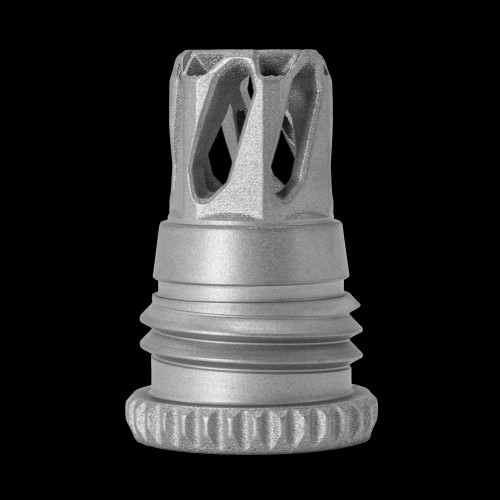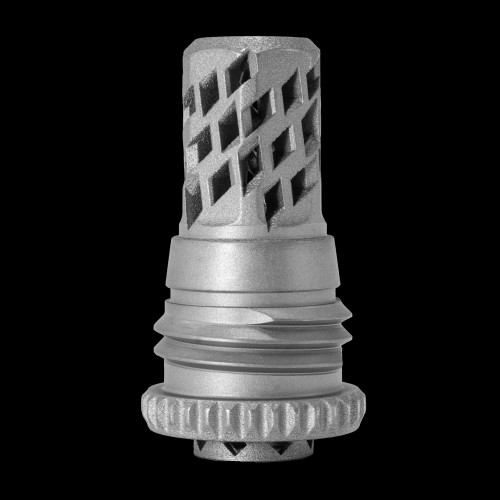


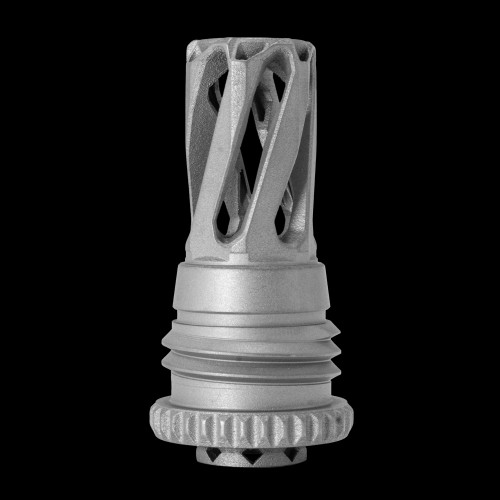
Suppressor-dedicated, flow-biased muzzle device.
The Macro Flow Enhancer (Macro FE) is the muzzle device for rifles that are realistically going to live suppressed. It is the muzzle device component of the Hesion Bow locking system and was built to improve suppressor performance at the muzzle instead of splitting its priorities between suppressed and unsuppressed use.
Where a general-purpose muzzle device has to preserve some level of unsuppressed civility, the Macro FE is freer to bias the system toward gas efficiency inside the can. That trade is intentional. It is meant to give compatible suppressors a cleaner start at the muzzle by prioritizing suppressor enhancement over bare-muzzle flash behavior.
| Overall Length | 2.5" |
| Caliber / Thread | 5/8-24, up to .338 cal |
| Caliber / Thread | 1/2-28, up to 6MM |
| Manufacturing | Laser Powder Bed Fusion (LPBF) |
| Taper Angle | 15 degrees included |
| Mount Interface | 1.125-8 American Buttress Thread |
| Diameter | 1.25" |
| Length Added to Barrel | 1.65" |
| Mount | Hesion Bow (U.S. No. 12460889) |
| Compatible Suppressors | Hesychia SIXK, Hesychia SIXK-H |
| MSRP | 195 |
The Macro FE is designed to maximize suppressor performance by sacrificing unsuppressed flash reduction. That is the core design decision behind the part. Instead of asking the muzzle device to do a little bit of everything, the Macro FE is shaped to support what happens after the bullet leaves the bore and enters the suppressor.
By driving unburned powder and high-pressure gas through the hollow tines directly into the suppressor’s annular intake, the Macro FE burns as much fuel as possible as early as possible. The less chemical energy that reaches the exit of the suppressor still looking for oxygen and heat, the less secondary flash there is for the shooter to deal with. Burn it sooner so it does not flash later.
- Muzzle device component of the Hesion Bow locking system
- Designed to maximize suppressor performance by sacrificing unsuppressed flash reduction
- Flow and jetting tuned for energy burn inside the can instead of outside
- Ideal for suppressor-only shooting with any hybrid suppressor
- No timing required for correct performance
Like the rest of the Hesion Bow family, the Macro FE is built around a 15-degree included taper and a 1.125-8 American buttress thread. The ridged base ring provides the locking indexes for the Hesion Bow pawls, while the coarse thread form is used to keep the mounting interface serviceable under heat, fouling, and repeated use.
The part installs with a 3/4" socket and does not require timing, with 30 ft-lbs of torque to the barrel. That keeps installation simple while preserving the same zero-backlash clamping logic used across the rest of the system.
- Uses a 3/4" socket for ease of installation
- No timing needed, 30 ft-lbs of torque to barrel
- Ridged base ring provides locking indexes for Hesion Bow pawls
- American Buttress Thread gaps allow gas bypass to help prevent carbon lock
The Macro FE is the correct choice when the rifle is functionally a suppressor host full time. In that role, sacrificing unsuppressed flash behavior is not a drawback. It is how the muzzle device buys more suppressor-focused performance where it actually matters.
If the rifle is going to spend most of its life with a can mounted, the Macro FE is the more honest solution than a mixed-use muzzle device. It gives the suppressor a better starting point at the muzzle and avoids pretending the host needs equal optimization for both conditions when it does not.
- Best suited to rifles that are realistically run suppressed full time
- Built for suppressor enhancement, not bare-muzzle compromise
- A better fit than a mixed-use device when unsuppressed flash behavior is not the priority
The Macro FE follows the same thread logic as the rest of the family, but the intended use remains suppressor-dedicated regardless of pitch.
1/2-28 Macro FE devices are rated up to 6MM. That gives them broader small-frame compatibility than a 5.56-only muzzle device, but the host should still be confirmed by the actual barrel markings before installation.
5/8-24 Macro FE devices are rated up to .338 cal. As always, thread pitch does not tell the whole story by itself, so actual caliber confirmation should come from the barrel, not assumptions based on thread pattern alone.
The Macro Flow Enhancer uses Inconel 718 so the muzzle device, suppressor body, and Hesion Bow HUB adapter share the same thermal behavior. When dissimilar alloys are mixed, such as a 17-4 muzzle device driving into an Inconel 718 taper, each material grows at a different rate as the system heats. The faster-growing component can wedge itself into the mating taper, gall the surface, and make the suppressor feel thermally locked once everything cools. Over time, those cyclic forces fatigue the taper interface instead of letting it stay clean and repeatable. On the Macro FE, the taper is also hollowed underneath so its cross-section thickness closely matches the taper sections on the suppressor and HUB adapter, further aligning the thermal profile across all three parts.
The Macro FE uses a coarse 1.125-8 American buttress thread because that profile was originally developed for hostile, dirty applications like tank barrels and artillery breech interfaces. The intentionally blunted crest of the thread increases impact and galling resistance and, just as importantly, leaves a relief path for gas to move if the taper seal is ever disturbed. That gas bypass path keeps carbon from compacting in the threads the way it does on fine-pitch, sharp-crested thread systems. In many traditional taper and thread locks, those fine threads give fouling nowhere to go and end up seizing the suppressor to the mount after hard use; the buttress geometry on the Macro FE is designed from the start to avoid that failure mode.
The Macro FE is compatible with Hesychia SIXK and Hesychia SIXK-H through the Hesion Bow mounting ecosystem. It remains the muzzle-side gas handling component whether the suppressor is a native mount or a HUB-format configuration.
That means the muzzle device still does the early work at the barrel, while the suppressor and any required adapter complete the mounting stack above it. The system stays consistent because the mount geometry, thermal logic, and thread strategy are all shared across the interface family.