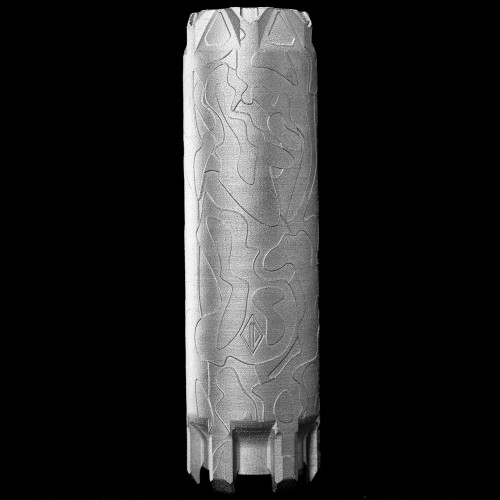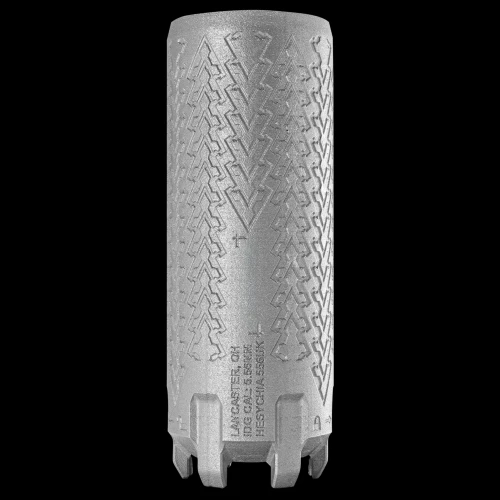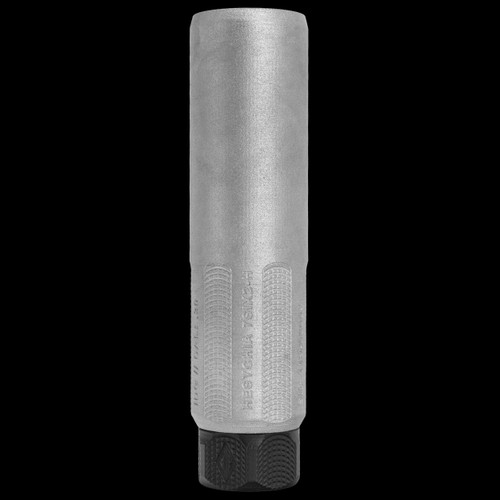


01 // Specifications
What the 7SIX2 Is Built Around
Expanded Specifications
| Caliber | 7.62MM |
| Weight | 16.7 oz |
| Overall Length | 6" |
| Length Added to Muzzle Device | 4" |
| Diameter | 1.75" |
| dB at Ear | Pending |
| dB at Muzzle | Pending |
| Test Platform | AR-10 16" Barrel |
| Material | Inconel 718 |
| Manufacturing | Laser Powder Bed Fusion (LPBF) |
| Gas Profile | Low Backpressure |
| Mount | Hesion Bow |
| Full Auto Rated | Yes |
| Full Auto Duration | 80 rounds of 7.62MM x 51MM in 30 seconds |
| Cooling Requirement | Cool to 140°F before subsequent strings |
| Compatible Muzzle Devices | Micro HFH, Micro FE |
| Barrel Guidance | 12.5" minimum for 7.62MM NATO and other supersonic 30 cal rifle cartridges |
02 // Engineering
Built to Run Full Auto in 7.62
Hesion Bow Lock System
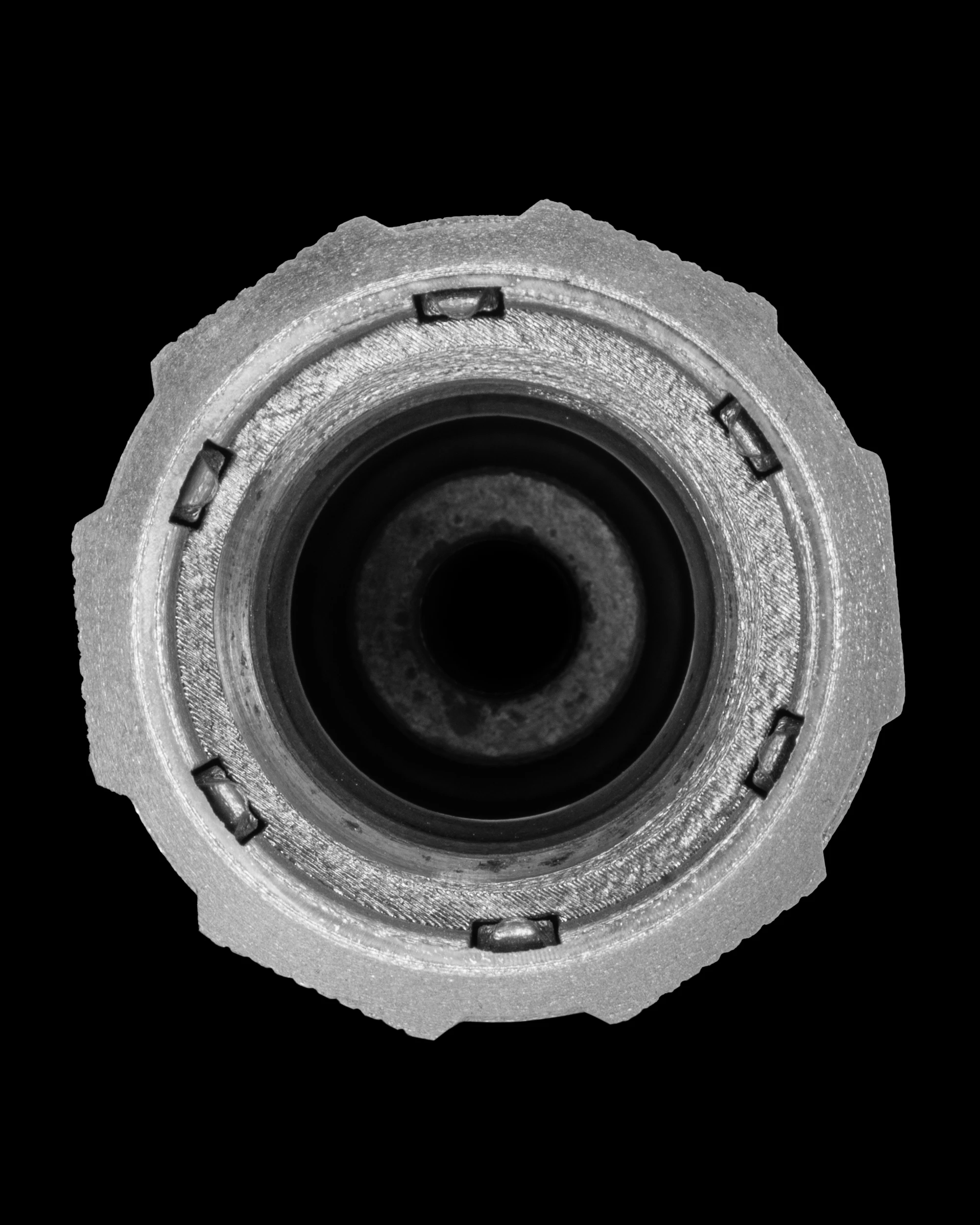
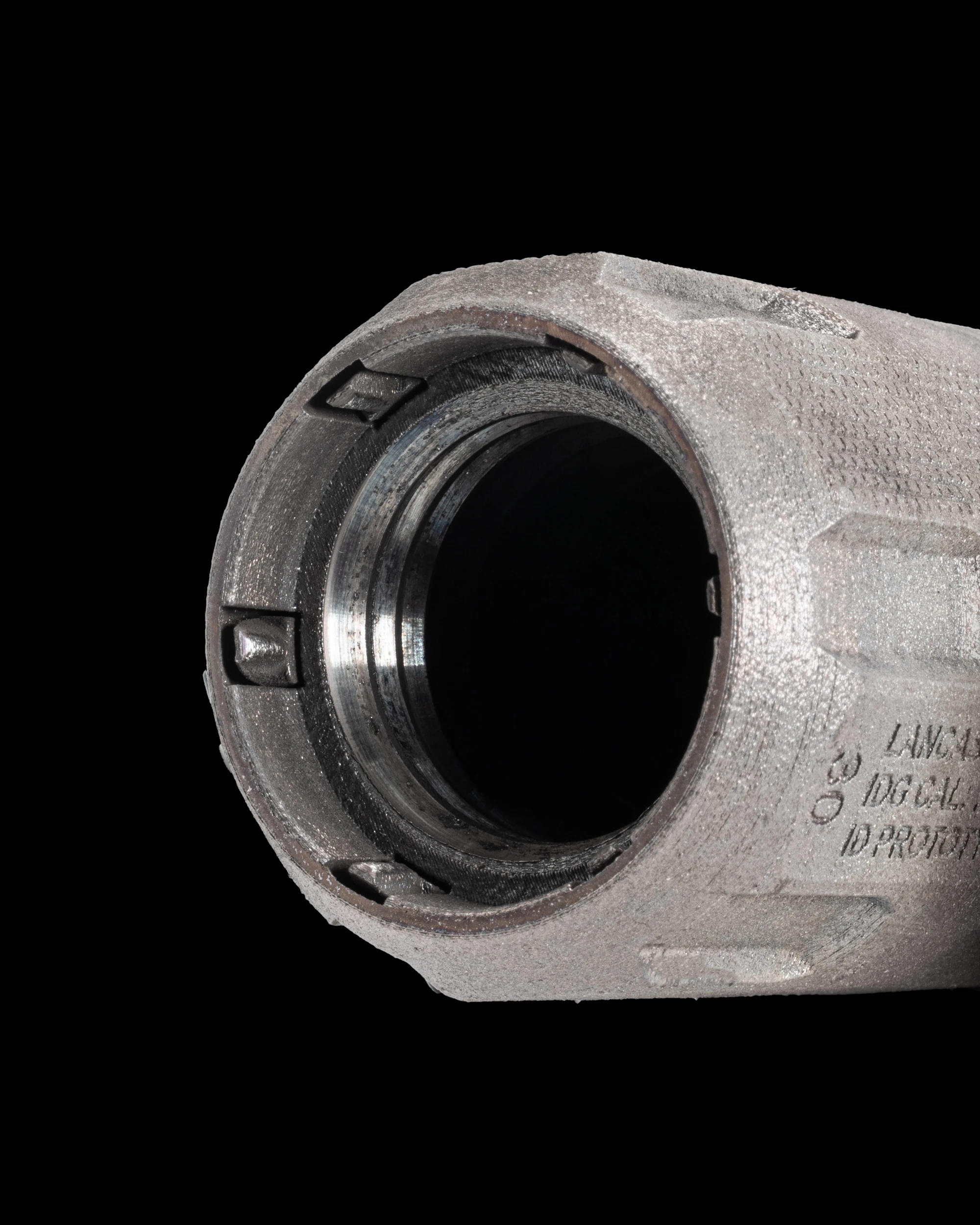
The Hesion Bow is the same dual-locking mechanism that runs across the HESYCHIA line, and it carries directly into the 7.62 platform without compromise. Flexure pawls are printed within the suppressor body under protective hoods to provide six bi-directional indexing arms that engage within 32 grooves around the outer edge of the muzzle device. It is the only secondary locking system that is integral to the suppressor itself, adding negligible weight to a can already built for sustained full-auto fire.
The primary lock is still the 15-degree taper and the 1 1/8"-8 left-hand American Buttress Thread. That taper geometry generates strong sealing force from modest torque, holding concentric alignment shot after shot as the system heats up under repeated strings of 7.62. The American Buttress Thread maximizes thread engagement and torque conversion, requiring only a few rotations to reach full taper lock.
A 7.62 host running sustained full auto puts more heat and more cyclic stress into the mount than most rifle suppressors will ever see. The Hesion Bow exists so that stress never becomes the shooter's problem. Two is one, one is none.
- Six flexure pawls printed into the suppressor body
- Thirty-two locking grooves on the muzzle device
- Integral redundant retention
- 15-degree taper primary lock
- 1 1/8"-8 left-hand American Buttress Thread
- Fast engagement, minimal rotation to full lock
Built for full auto. Not just rated for it.
Gas Management
Manage pressure early. Manage heat the whole way through.
The 7SIX2 carries the same low-backpressure gas management logic as the rest of the HESYCHIA family, built around the blast chamber, early intake geometry, and first redirections rather than treating back-pressure as something to fix downstream. On a 7.62 host, that early control matters even more, because every additional round of back-pressure gets multiplied across a heavier bolt carrier and a hotter gas system.
The goal was never to simply trap more gas and let the host absorb it. The goal was to move pressure off the muzzle early, route it with intent through the suppressor body, and keep the rifle cycling like itself, even across an 80-round string fired in 30 seconds.
Monolithic Inconel 718 Construction
Designed for heat first. Inconel 718 is what makes sustained 7.62 full auto survivable.
Laser Powder Bed Fusion allows the internal geometry to be built around gas and heat behavior instead of being constrained by drill paths, lathe access, or stacked components. Early annular intakes, shielded ports, monolithic pawls, and heavy internal filleting are only possible because the body is printed as a single piece, with critical interfaces machined afterward.
Inconel 718 is the material choice specifically because of what the 7SIX2 is rated to do: 80 rounds of 7.62x51 in 30 seconds, run repeatedly as the suppressor cools back to 140°F between strings. It holds its shape, resists erosion, and survives thermal cycling that would deform a lighter or cheaper alloy. It is not the lightest option. It is the one that keeps working after the barrel gets hot.
Muzzle Device Logic
Micro HFH
Use the Micro HFH when the rifle spends meaningful time both suppressed and unsuppressed. It is the more balanced choice for a mixed-use host, with a stronger unsuppressed flash outcome when the can comes off.
Micro FE
Use the Micro FE when the host is realistically going to live suppressed. It is part of the suppressor's first-stage gas control, developed to maximize suppressed performance by routing gas aggressively into the early internal geometry.
The Micro HFH and Micro FE do different jobs. The HFH is the better all-around answer when the rifle has to perform both suppressed and unsuppressed. The FE makes the most sense when the host is essentially suppressor-dedicated and the priority is suppressed performance over unsuppressed civility.
Design Envelope
The 7SIX2 is full auto rated for 12.5" barrels and above. That minimum was set specifically around high-pressure, supersonic 30 caliber rifle cartridges, not subsonic loads. Going shorter increases blast baffle erosion and raises projectile stability risk.
The design target was not the shortest possible package. The design target was a 7.62 suppressor that could absorb an 80-round, 30-second full-auto string of hot, supersonic 30 cal ammunition, cool back to 140°F, and do it again, without requiring the customer to retune the host just to keep the system running the way it should.
03 // Maintenance
Keep It Running
The 7SIX2 is a sealed monolithic unit. There are no user-serviceable internal components and no baffles to remove individually. Maintenance is straightforward. Start with correct setup logic, a clean interface, proper taper seating, and realistic expectations around thermal cycling under full auto.
Mounting Basics
Start with clean parts, correct torque, and proper taper engagement. Install the muzzle device to the barrel at 30 ft./lbs. Timing is not required for the Micro HFH or Micro FE, and threadlocker is not normally required under standard installation. Before mounting, make sure the taper and mating surfaces are clean so the suppressor seats on the taper rather than hanging up on dirt, debris, or a false stop.
Break-In and Validation
New systems should be mounted, seated, removed, and repeated for roughly 5 to 7 cycles. That initial wear-in helps the interfaces settle the way they were designed to. After that, do a short validation firing sequence and inspect for stable mounting, normal recoil impulse, no evidence of walk-off, and no indication that the host or can is doing something unexpected.
Thermal Cycling
The 7SIX2 is rated for 80 rounds of 7.62x51 in 30 seconds. Between strings at that pace, let the suppressor cool to 140°F before firing the next string. This is a thermal management guideline, not a suggestion that the can is fragile. It exists so the system performs consistently across repeated full-auto use rather than being pushed into a use case it was not built for.
Stop and Inspect
Stop and inspect if the suppressor does not seem to seat consistently, if you do not see the expected slight rear gap, if the mount feels gritty, uneven, or vague after repeated attempts, if you suspect alignment is off, or if the can appears to walk off during early firing. In most cases, walk-off is not magic. It usually means the taper was not fully seated or the interface was dirty when the system was mounted.
- Install muzzle devices to the barrel at 30 ft./lbs.
- No timing required for Micro HFH or Micro FE
- Threadlocker is not normally required under standard installation
- Cycle the mount 5 to 7 times on a new system
- Cool to 140°F between full-auto strings