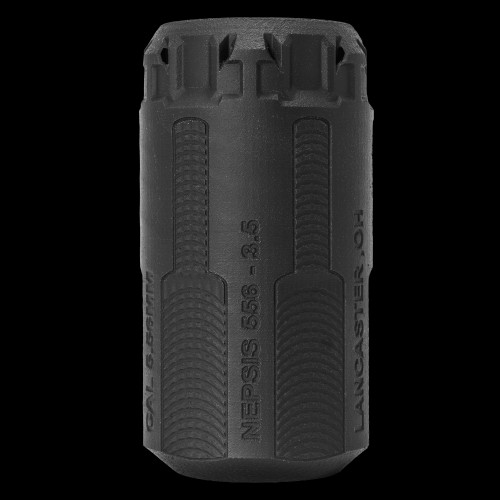


What the Nepsis 4.5 Is Built Around
Expanded Specifications
| Caliber | 5.56MM NATO |
| Weight | 13 oz |
| Overall Length | 4.5" |
| Diameter | 1.75" |
| Mount | Direct Thread |
| Thread Pitch | 1/2x28 |
| Blast Chamber | Direct Thread Enhanced |
| Gas Profile | Low Backpressure |
| dB at Ear | Pending |
| dB at Muzzle | Pending |
| Material | Inconel 718 |
| Manufacturing | Laser Powder Bed Fusion (LPBF) |
| Full Auto Rated | Yes |
| Barrel Guidance | Full auto rated for 10.3" barrels and above (best performance) |
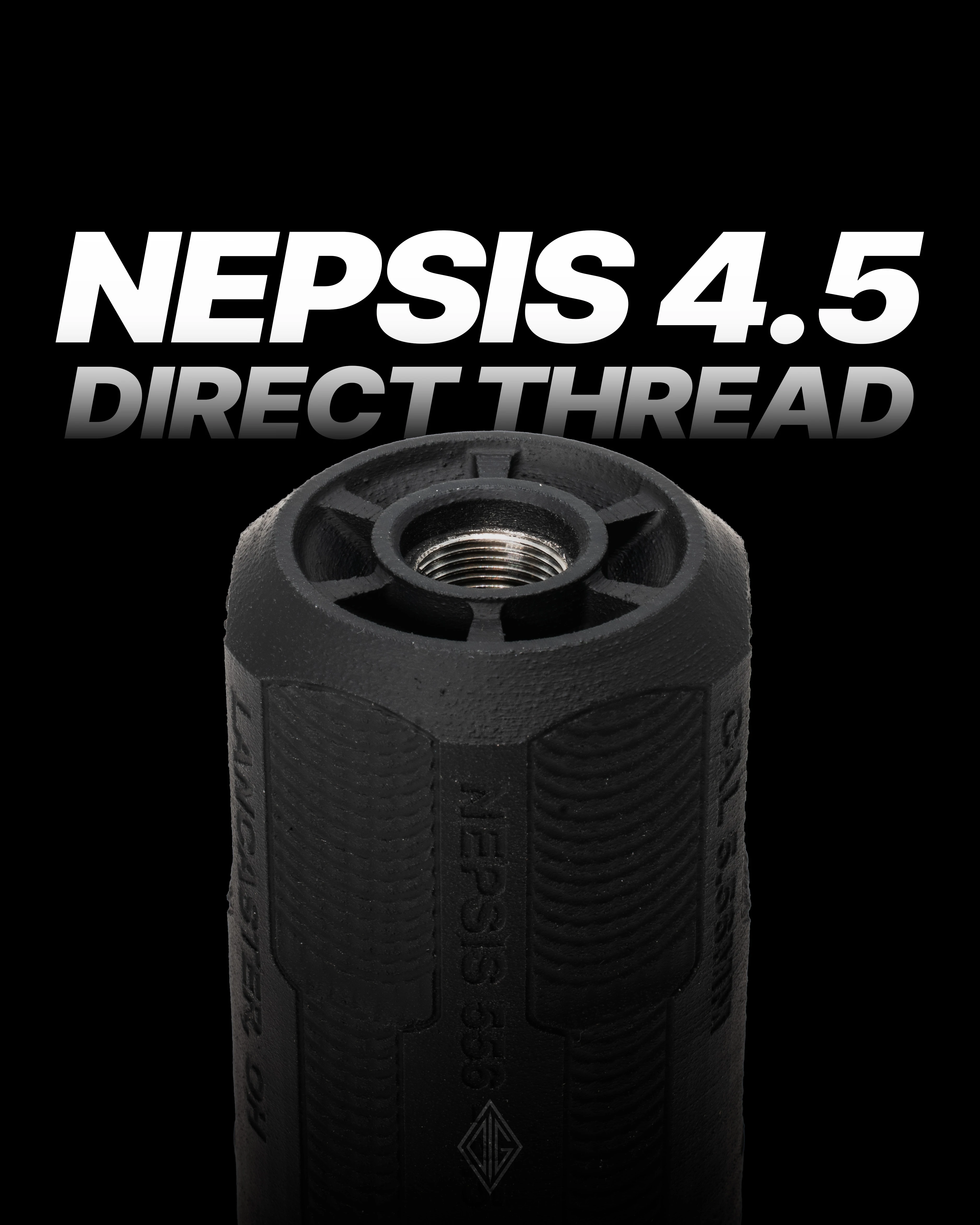
A Smarter Blast Chamber Behind a Simple Mount
Traditional direct thread suppressors treat the muzzle as nothing more than a mounting point. They thread onto the barrel and send that first violent burst of heat and gas straight into a single blast baffle, which takes the full hit on its own.
The Nepsis 4.5 keeps the mount simple: 1/2x28 direct thread, straight onto the barrel. What changes is what happens behind it. The Direct Thread Enhanced blast chamber is built to do real work instead of acting as an empty space in front of one sacrificial baffle.
- 1/2x28 direct thread mount
- Direct Thread Enhanced blast chamber geometry
- Initial gas redirected into optimized areas of the can
- Low back pressure
- 4.5" overall length at 13 oz
We know the blast chamber can do more. The Nepsis 4.5 uses blast chamber geometry built to redirect the initial gas into optimized areas of the suppressor, where it dissipates immediately instead of slamming into a single surface.
Because the blast is managed from the moment it leaves the muzzle, the internal baffles downstream can work more efficiently, the way they were designed to. The first pressure event is handled up front rather than left as a problem for the rest of the can.
The muzzle is just a mounting point. The first burst of heat and gas goes straight into a single blast baffle, which absorbs the full hit on its own.
The blast chamber redirects initial gas into optimized areas where it dissipates immediately, so the baffle stack behind it can work the way it was designed to.
Handling the blast correctly at the start pays off across the whole system. The Nepsis 4.5 delivers a massive reduction in sound, recoil and flash while keeping back pressure low, so the host keeps running like itself.
That combination is what enhances shooter safety and enjoyment: less noise at the ear, less gas in the face, and a rifle that does not need to be rebuilt around its suppressor.
Give the shooter the simplicity of a direct thread suppressor without accepting the usual direct thread penalties. A compact 4.5" package, low back pressure, strong reduction in sound, recoil and flash, and a blast chamber that does real work from the first shot.
We designed a suppressor system that does not need any tuning for any firearm host it mounts to. If the customer has to spend additional money on adjustable gas blocks, heavier buffers, or different springs just to make our suppressor work on their rifle, then we did not hit our goal. Can you tune your firearm to run it even better? Absolutely. But it is not required.
Keep It Running
Direct thread mounting is simple, but it still depends on clean threads, a square barrel shoulder, and verified alignment. Most direct thread problems start with setup, not with the suppressor.
Start with clean threads and a clean shoulder. Make sure the barrel's 1/2x28 threads and shoulder are free of carbon, debris, and damage. Thread the suppressor on by hand until it seats fully against the shoulder, then snug it firmly. It should seat flat and square with no wobble.
Before firing, confirm bore alignment with an alignment rod. A shoulder that is not square to the bore, or threads that are not concentric, can put the suppressor out of line with the projectile's path. Verify on every new host.
Heat cycles can loosen a direct thread mount. Check that the suppressor is still tight after your first strings and periodically during longer sessions, once it has cooled enough to handle safely.
Stop and inspect if the suppressor will not seat flat against the shoulder, if it loosens repeatedly, if alignment looks questionable, or if you see any sign of contact at the end cap. Address the cause before firing again.
- Clean barrel threads and shoulder before mounting
- Seat fully and squarely against the shoulder
- Verify alignment with a rod on every new host
- Recheck tightness after the first strings
- Inspect any time the mount loosens or alignment is in doubt
For the full engineering deep-dive, visit our Tech Talk page. For setup questions and compatibility details, check the IDG FAQ.